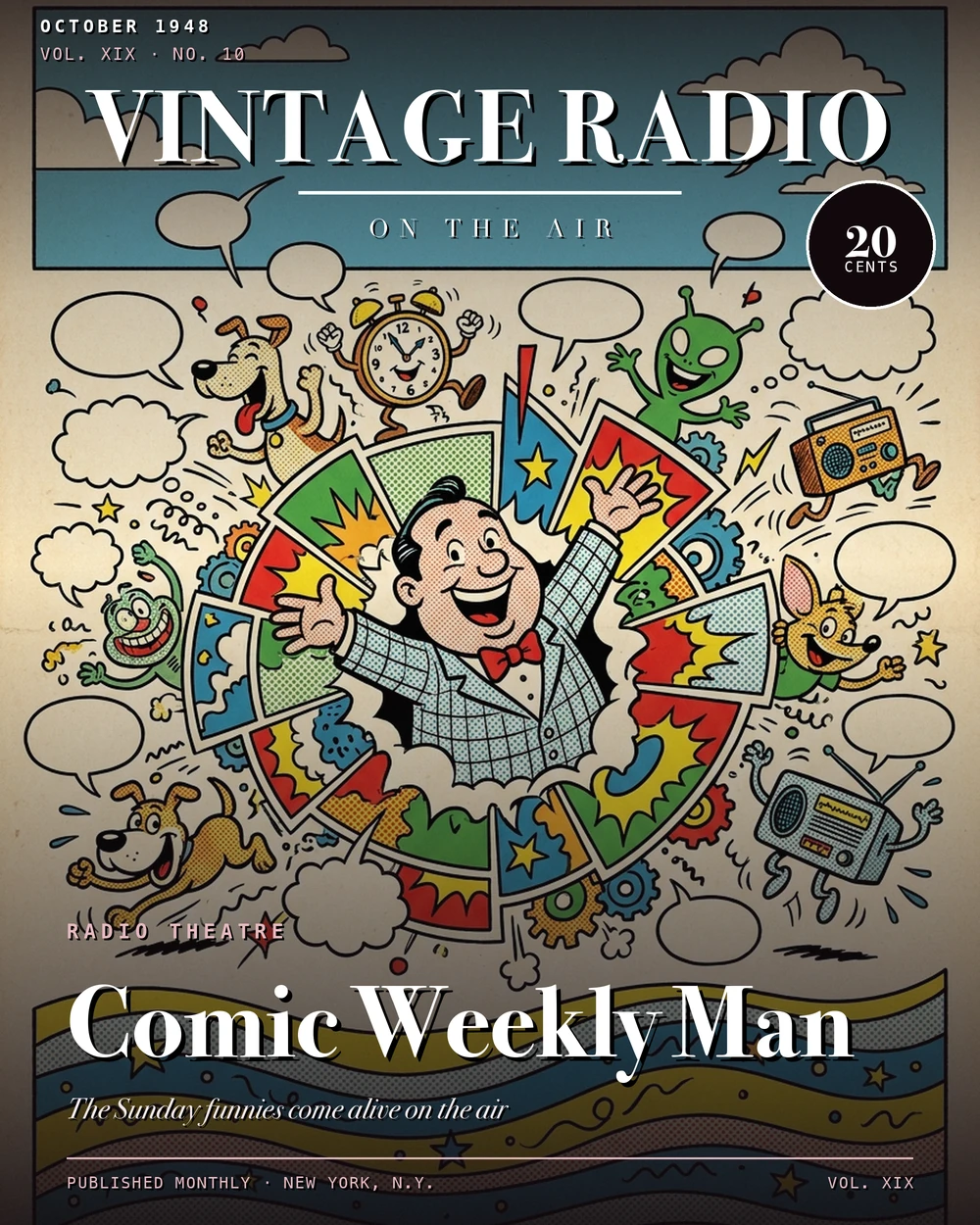
Comic Weekly Man
The Idea Behind the Show
Comic Weekly Man had a premise that no other nationally syndicated radio program quite matched: it was designed to be heard alongside a newspaper. Specifically, listeners were meant to have their copy of Puck – The Comic Weekly open on their laps while the show aired — following along in print as the radio dramatized what was on the page in front of them. That multimedia hook was the show's reason for being. Puck – The Comic Weekly was the four-color tabloid Sunday comics supplement distributed through William Randolph Hearst's newspaper chain, and the radio program was a direct extension of that print property, syndicated to stations that purchased it and distributed to markets where the Hearst Sunday paper circulated.
The practice of reading Sunday comics on the radio wasn't brand new when the show launched. Local versions had been around since roughly 1930, with figures like "Uncle Bob" in Chicago and "Uncle Don" in New York doing their own informal versions for local audiences. Comic Weekly Man was the nationally syndicated, Hearst-backed outgrowth of that tradition — the version that had King Features Syndicate behind it and a full cast and scripts rather than someone improvising at a microphone.
The full run on the Mutual Broadcasting Network stretched from April 27, 1947 to November 21, 1954. The surviving episode catalog, however, begins with Episode 172, recorded August 6, 1950 — meaning the first 171 episodes, covering roughly the show's first three years, are not known to exist in recorded form. What survives represents the back half of a longer run.
Lon Clark and Little Miss Honey
The person who made the show work, at least across the surviving episodes, was radio actor Lon Clark, who served as host and primary performer. Clark voiced all the male characters across every comic strip segment each week, and he also wrote the program's scripts — reportedly after receiving an initial draft he felt didn't speak to children in the right way and deciding to rewrite it himself.
Alongside Clark was a female co-performer billed as "Little Miss Honey," who voiced female characters, delivered jokes and riddles to the audience, and cued Clark to move from one strip to the next. The format gave the show a conversational spine: Clark and Miss Honey would trade a riddle or a gag, then launch into a dramatized strip segment, then return to banter before the next one. Each episode ran approximately 28 minutes and opened with Clark singing a jaunty theme song.
What makes Clark's involvement unusual is that he deliberately took no on-air credit for the show. His reasoning, reportedly, was that he didn't want to be publicly identified with a children's program while he was pursuing dramatic work elsewhere. That "elsewhere" was substantial: Clark was simultaneously playing the title role in Nick Carter, Master Detective on Mutual from 1943 to 1955, one of the longer-running crime dramas on that network. The same actor was solving murders on one Mutual program and singing a comic strip theme song on another, without most listeners knowing it. Clark passed away on October 2, 1998, at St. Clare's Hospital in Manhattan at the age of 86.
One earlier detail worth noting: sources indicate that an unnamed performer held the host role before Clark took it over, though who that was hasn't been clearly established.
What Was Actually on the Show
The strips dramatized across the run covered a wide range of the Hearst/King Features lineup. The most prominent presence in surviving episode titles is Hopalong Cassidy, whose segments appear repeatedly. Beetle Bailey shows up regularly as well, along with Rusty Riley, Blondie, Hi and Lois, Flash Gordon, Roy Rogers, Scamp, Little Iodine, and Bringing Up Father — the strip built around the character Jiggs. Snookums, Ben and Me, and The Sword and the Rose also appeared at various points.
The episode titles themselves give a good sense of the show's texture. Alongside straightforward strip titles — "Rusty Riley to Live on Farm," "Eager and Anxious" — there are recurring riddles embedded right in the titles: "Wet Coat Riddle," "At Sea Riddle," "Mr Bigger Riddle," "Why Is a Dogs Tail Like the Center of a Tree." These weren't incidental. The riddles were a structural element, part of the back-and-forth between Clark and Miss Honey that stitched the variety segments together. The show also incorporated music throughout, mixing dialogue, brief comic adaptations, and running gags in a variety format designed to hold a family audience for the better part of a half hour.
The audience Comic Weekly Man was aimed at was explicitly families and children — the same people who were already reading the Sunday funnies. The Hearst connection meant the show had a built-in promotional channel through the newspaper chain, and local radio stations that carried the program were, in effect, supporting the Hearst Sunday supplement in their market.
How Long It Ran and What's Left
By the time the show ended on November 21, 1954, it had been running on Mutual for more than seven years. That's a substantial run for any program, and it says something about how reliably the format served its purpose — a weekly half-hour that gave Sunday comics fans something to do with the strips they'd already read (or were reading at that moment).
The 109 known surviving episodes cover August 6, 1950 through December 13, 1953, leaving a gap at both ends of the full run. The earlier years — when the show was establishing itself, when the first performer held the role before Clark, when the strip lineup was presumably being worked out — are gone. So is the final year of broadcasting. What remains is a substantial middle section: enough to get a clear picture of what the program sounded like and how it was structured, but not a complete document of the show's full life.
For a program built around an ephemeral medium (radio) promoting another ephemeral medium (the Sunday newspaper supplement), 109 episodes is a meaningful preservation. The Puck – The Comic Weekly supplement itself kept running in Hearst papers through the 1970s, long outlasting the radio version that had once been its broadcast companion.